
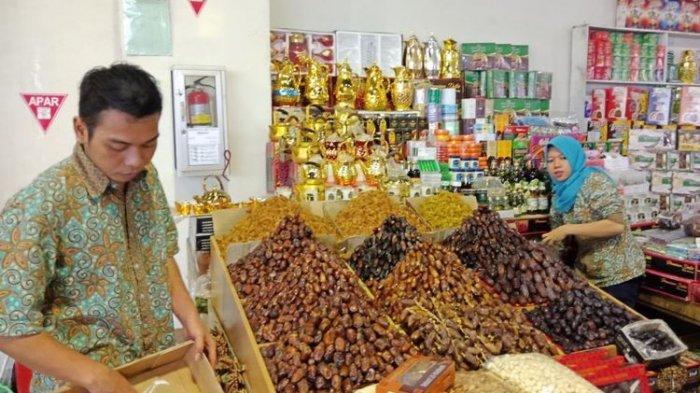
A kedai kurma in Malaysia can get very crowded in the weeks before Ramadan, with cartons stacked to the ceiling and open trays on the counter. Every date on those shelves came from abroad, so it pays to read the labels closely. This guide covers what a dates shop worth calling "premier" should carry, what one Malaysian wholesaler was charging in November 2026, and how to handle kurma segar, the soft fresh-stage dates, once they leave the shop.

Every date in the shop is imported
Start with one plain fact. Malaysia has no commercial date-growing trade, so every date sold here is imported. When a shop says its stock is "fresh", it means fresh-stage fruit that travelled well, not fruit picked down the road.
Demand is not flat through the year either. It peaks before and during Ramadan, and Hari Raya, wedding hantaran, kenduri and umrah gifts are other peaks. A busy shop at those times is normal. A shop with tired, sticky trays in a quiet month tells you more about its turnover.
The varieties a good kedai kurma should stock
A serious dates shop in Malaysia carries more than one or two names. The table below lists seven varieties you may meet, with the origin and texture you should expect. If a seller describes them very differently, ask why.
| Variety | Origin | What it is like |
|---|---|---|
| Ajwa (also sold as "Kurma Nabi") | Madinah, Saudi Arabia | Small, roundish, near-black, finely wrinkled skin, soft |
| Safawi | Madinah region, Saudi Arabia | Longer than Ajwa, dark brown to black, soft and chewy |
| Medjool | Originated in Morocco; the Medjool in this guide's price list is from Palestine | Large, very soft, rich caramel taste |
| Mazafati (rotab, "kurma madu") | Bam, Kerman province, Iran | Dark, very soft, high moisture, needs refrigeration |
| Mariami | Iran | Dark, semi-dry, chewy |
| Sukari | Al-Qassim, Saudi Arabia | Golden-amber, very sweet, sold soft (rutab) or drier |
| Deglet Noor ("kurma tangkai" on the stem) | Tunisia / Algeria | Golden, translucent, semi-dry |
Two of these need a closer look. Mariami is its own variety from Iran, and Deglet Noor on the stem is North African, whatever the stem might suggest. There is a longer piece on Mariami as a premium choice if that is the box you are weighing up.
What "kurma segar" actually means on a shop shelf
Dates are sold at different stages of ripeness, and that is what decides how fresh, or segar, a box really is. The FAO date palm handbook says whole dates are harvested and marketed at three stages: khalal, rutab and tamar. Khalal is the hard, coloured stage, and the handbook notes that dates reaching khalal are regarded as ready for trading as "fresh" fruit. Rutab, or rotab in Malaysian shops, is the soft fresh-ripe stage. Tamar is fully ripe and drier.
Only tamar keeps easily. FAO says dates in all the stages except tamar are perishable because of their high water content, and that rutab fruit quickly turns sour unless it is cold stored. Tamar has lost most of its water, which FAO calls the best condition for storage.
So when you buy kurma segar, you are buying the fruit that needs the most care. Mazafati is one example. It is cold-stored and sold year-round, so seeing soft rotab on the shelf in, say, September is nothing to be suspicious about. What matters is whether the shop kept it cold the whole way. Look for a working chiller, not a carton by the door.
Prices one wholesaler was charging (checked November 2026)
Prices move with grade and pack size, so a fair comparison needs both. These figures come from one Malaysian wholesaler's list, checked in November 2026. All ten were sale prices shown next to a higher regular price, and stock changes, so treat the list as a snapshot.

| Pack | Price | Stock on the day |
|---|---|---|
| Ajwa A 2026, 1kg | RM31 | In stock |
| Ajwa AA 2026, 1kg | RM36 | In stock |
| Ajwa AAA VIP (Large), 1kg | RM44 | In stock |
| Safawi A, 1kg | RM35 | In stock |
| Safawi AAA Jumbo, 1kg | RM45 | In stock |
| Mariami AAA, 1kg | RM40 | In stock |
| Medjool Palestin Jumbo, 900g box | RM70 | In stock |
| Rotab Sukkary Premium, 3kg | RM63 | In stock |
| Rotab Mazafati AAA, 12 x 600g | RM86 | Out of stock |
| Kurma Muda Palestine, 5kg | RM125 | Out of stock |
Look at the three Ajwa rows. Same variety, same 1kg, and RM13 between the A and the AAA VIP. That gap is grade. Grades like A, AA, AAA and Jumbo are each importer's own size sorting, not an international standard, so an "AA" from one shop and an "AA" from another may not match. Ask to see both grades side by side before you pay for the higher one.
Both the Rotab Mazafati and the Kurma Muda packs were out of stock when checked. That is a useful reminder for anyone planning kurma segar for an event: ask the shop about stock early rather than the week before.
Signs of a well-run dates shop
These are the plain things a careful buyer checks at the counter. None of them need special knowledge.
The grade and pack size are written on the label, so you can compare like with like. The origin is stated, and it matches the variety table above. Ajwa should say Madinah. Deglet Noor should say Tunisia or Algeria. Mazafati sits in a chiller. Open trays are covered. The staff will tell you the price per pack without a sales pitch, and they can say which boxes are this season's stock.
For bigger orders, the same rules apply with more at stake. A 5kg carton is a lot of fruit to find out is the wrong grade. Our guide to buying kurma borong online walks through carton formats and per-kilo maths.
What 100 grams of dates gives you
The original version of this page talked about nutrients in general terms. Here are the actual figures from USDA FoodData Central (SR Legacy records, last updated 2019), per 100g:
| Per 100g | Medjool | Deglet Noor |
|---|---|---|
| Energy | 277 kcal | 282 kcal |
| Dietary fibre | 6.7 g | 8.0 g |
| Potassium | 696 mg | 656 mg |
| Magnesium | 54 mg | 43 mg |
Those numbers are for the fruit itself, so a Medjool and a Deglet Noor are close on energy, while Deglet Noor has a little more fibre per 100g. Medjool fruit is large, which is worth remembering when you count them out. If the potassium figure is why you are reading, there is a separate article on dates and potassium research on this site.
Taking kurma segar home
Soft dates are the ones to plan for. Mazafati needs refrigeration, so it goes in the fridge as soon as you get home, and FAO's note that rutab quickly turns sour unless cold stored applies to other rotab too. FAO notes that dates at the tamar stage, protected from insects, can be kept without special precautions over longer periods.
For Medjool you plan to keep a long time, freezing is a sensible option. The FAO handbook says −18°C is the temperature commonly used for long-term preservation of several varieties including Medjool, and that it reduces water loss, sugar crystallisation and skin separation. Split a big box into smaller bags first so you only thaw what you need. More on that variety is in our piece on the rise of Medjool from Palestine.

Dates have uses in the kitchen too. FAO lists date syrup (dibs), used to sweeten various foods, and sauces such as chutney, where the dates give sugar and body. You can also chop a few soft dates into a salad with greens and nuts, as in the photo above.
Quick questions
Is rotab sold outside Ramadan a bad sign?
No. Mazafati is cold-stored and sold year-round. Check that it has been kept chilled, and that is enough.
Are higher grades a different variety?
No. Grade is the importer's own size sorting. Ajwa A and Ajwa AAA VIP are both Ajwa, sorted by size.
Does kurma tangkai come from Madinah?
Kurma tangkai is Deglet Noor sold on the stem, and it comes from Tunisia or Algeria. The stem says nothing about Madinah.
More about this site is on the About page and the contact page.